
Power Distribution


Electrical Protection and Switching Devices — concise guide

Your summary is complete and accurate. Below is a compact, practical reference you can use for selection, coordination, installation, and maintenance of protection and switching devices in low‑voltage power distribution.

Quick device map

Device Primary function Typical Schneider product line
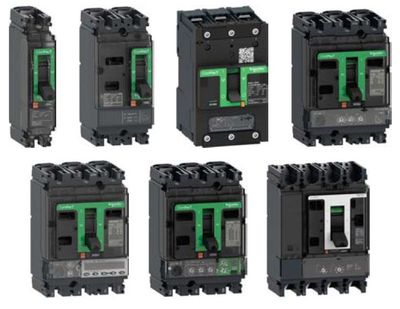
MCCB (Moulded Case CB) Protect cables/machines from overloads and short circuits ComPact; ComPact NSX
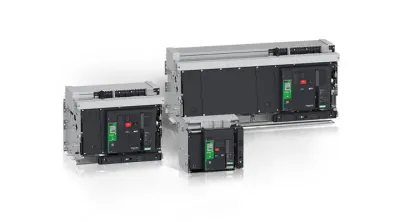
ACB (Air CB) High‑capacity protection and selective breaking in LV switchgear MasterPact
Motor protection CB / Starter Combined short‑circuit and overload protection for motors GV / TeSys
Switch disconnector / Isolator Provide visible isolation for safe maintenance MasterPact; ComPact; FuPact
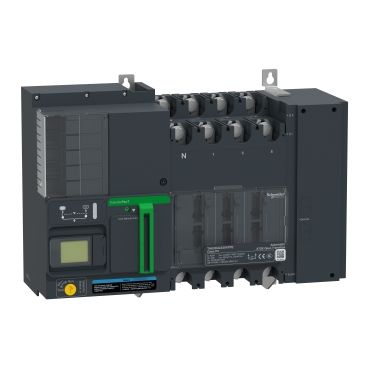
Transfer switch Automatic/manual source transfer for backup power TransferPact
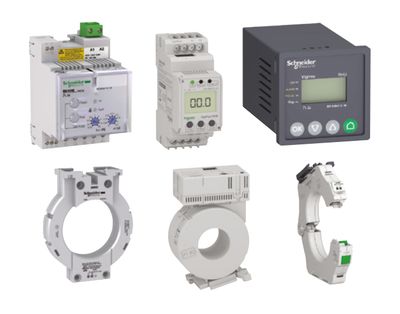
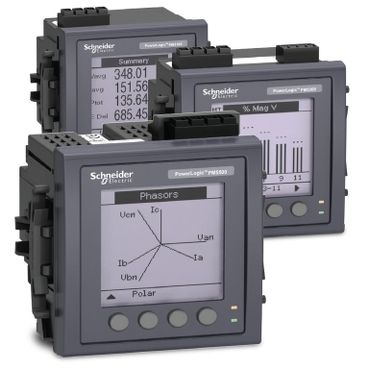
Auxiliary devices Signalling, interlocks, suppression, metering Harmony; TeSys accessories; PowerLogic

Selection checklist (practical)

  • Rated current and breaking capacity — choose a device with a continuous current rating ≥ expected load and breaking capacity ≥ prospective fault current.
  • Coordination & selectivity — verify upstream/downstream devices are time/current coordinated to limit outage scope.
  • Application type — use ACBs for main incomers and MCCBs for feeders and machine protection.
  • Motor protection — match motor full‑load current (FLA), starting current, and service factor; prefer motor‑rated breakers or TeSys starters for direct online or reversing starts.
  • Environmental conditions — check ambient temperature, altitude, humidity, corrosive atmosphere, and required IP rating.
  • Control & metering needs — include trip units with adjustable curves, electronic protection, and energy metering where required.
  • Backup power strategy — choose automatic transfer switches (ATS) for critical loads; size for generator and utility characteristics.

Coordination and selectivity (how to approach)

  • Establish fault current levels at each bus and feeder.
  • Select protective curves(thermal/magnetic or electronic trip curves) to ensure downstream devices clear faults before upstream devices operate.
  • Use time‑delay settings and inverse time characteristics for discrimination.
  • Document coordination study and update after any system change.

Installation best practices

  • Correct cable sizing and torque — follow manufacturer torque values and derating rules.
  • Proper earthing and bonding — ensure protective earthing and equipotential bonding are continuous.
  • Clear isolation — install visible disconnects and padlockable isolators for safe maintenance.
  • EMI suppression — fit coil suppressors and RC snubbers on inductive loads to extend contact life.
  • Labelling and documentation — label all devices, circuits, and protective settings; keep wiring diagrams and trip settings with switchgear.

Testing, commissioning, and maintenance

  • Pre‑commission tests: insulation resistance, continuity, polarity, functional trip tests.
  • Commissioning: verify trip unit settings, perform primary injection tests for breakers, and test ATS transfer sequences.
  • Routine maintenance: visual inspection, contact wear checks, thermal imaging under load, mechanical operation tests, and firmware updates for electronic trip units.
  • Periodic testing intervals: annual visual and electrical checks; more frequent checks for critical or high‑duty installations.

Standards and documentation to follow

  • IEC 60947 family for low‑voltage switchgear and controlgear.
  • IEC 60909 for short‑circuit current calculations.
  • Local electrical codes and utility interconnection requirements.
  • Manufacturer datasheets and coordination guides for trip curves and setting recommendations.

Practical tips for reliability and safety

  • Use electronic trip units where adjustable protection and event logging are valuable.
  • Keep spare trip units and critical spares for fast replacement.
  • Implement remote monitoring for key breakers and ATS to detect trends and enable predictive maintenance.
  • Train staff on isolation procedures, lockout/tagout, and breaker operation.