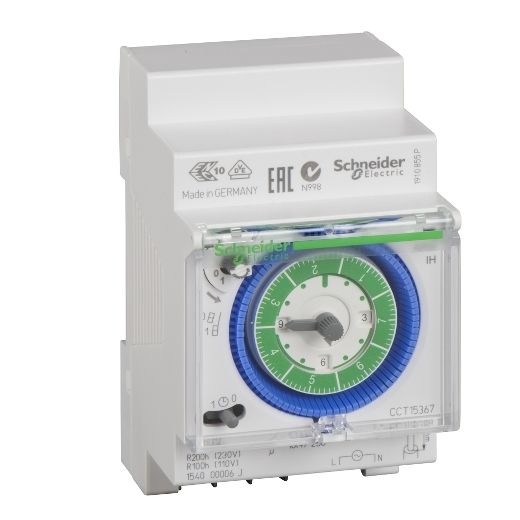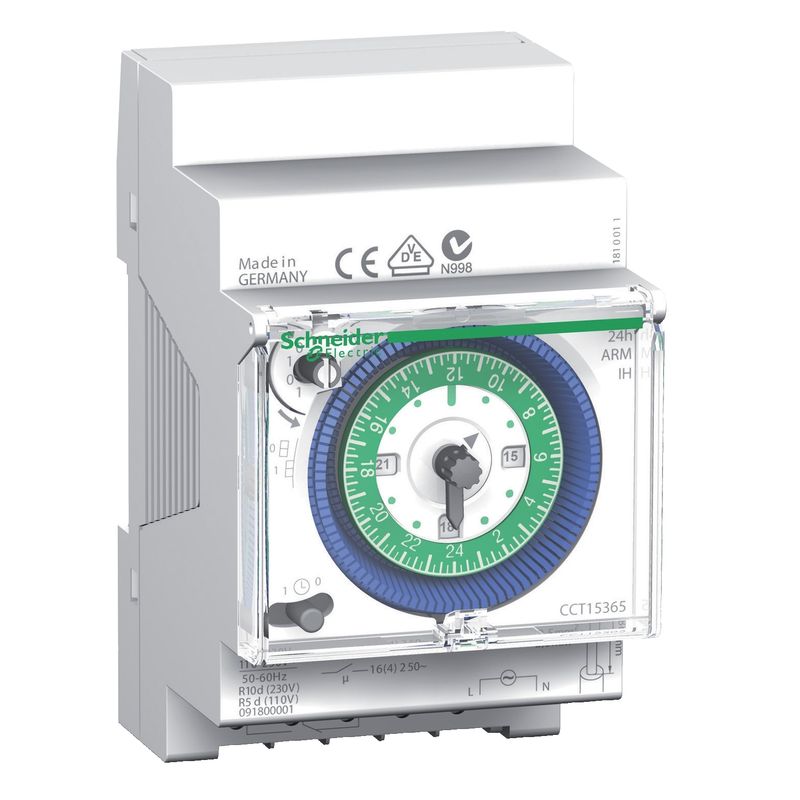

Mechanical Time Switch
A mechanical time switch is a device that controls the switching ON and OFF of electrical circuits using a mechanical clock mechanism. It operates according to a pre‑set schedule and is widely used where simple, reliable time‑based control is required.
Key Features
Mechanical Clock Mechanism
- Uses gears and a synchronous motor to rotate a clock dial at a constant rate.
- Timekeeping is typically driven by the electrical supply frequency.
Manual Time Setting
- Equipped with pins, tabs, or segments around the dial.
- Each pin or segment represents a fixed time interval (e.g. 15 or 30 minutes), allowing users to set ON and OFF periods manually.
Power Supply
- Operates while connected to the mains supply.
- Does not rely on digital memory or software to maintain switching logic.
Robust Construction
- Minimal electronic components.
- Designed for long service life and resistance to harsh operating conditions.
Manual Override
- Most models include an override switch to force the circuit ON or OFF without changing the programmed schedule.
Benefits
Simplicity
- Intuitive operation requiring no programming knowledge.
- Settings are visible and easy to adjust.
Reliability
- Mechanical operation reduces susceptibility to electronic faults.
- Performs consistently in environments with electrical noise or interference.
No Programming Memory Required
- No dependency on software or complex electronics.
- Some models continue to operate without batteries; others may use a small reserve for short power interruptions.
Cost‑Effective
- Generally lower cost than digital time switches.
- Minimal maintenance requirements.
Typical Applications
Lighting Control
- Garden and pathway lighting
- Security and façade lighting
- Decorative and seasonal lighting
Heating Systems
- Water heaters
- Space heating systems
- Electric towel rails
Pumps and Motors
- Pool pumps
- Irrigation systems
- Small industrial machinery
Household and Commercial Appliances
- Ventilation fans
- Coffee machines
- Display lighting and signage
How It Works
- Setting the Schedule
The user positions pins or segments on the rotating dial to define the desired ON and OFF times. - Continuous Rotation
The dial rotates continuously at a fixed speed, typically completing one full cycle every 24 hours. - Circuit Switching
As the dial rotates, the pins engage internal contacts:- Closing the circuit at programmed ON times
- Opening the circuit at programmed OFF times
- Manual Override (if fitted)
The override switch allows immediate manual control without disturbing the preset schedule.
Example Application
To automatically run garden lighting from 18:00 to 23:00 daily:
- Insert pins at the 18:00 and 23:00 positions on the dial.
- Connect the time switch to the supply.
- Plug the lighting circuit into the time switch.
As the dial rotates:
- At 18:00, the contacts close and the lights turn ON.
- At 23:00, the contacts open and the lights turn OFF.
This sequence repeats every day without further input.
Summary
Mechanical time switches provide a simple, robust, and economical solution for automating electrical circuits based on time. Their ease of use, durability, and predictable operation make them ideal for applications where basic scheduling is sufficient and complex programming is unnecessary.
They remain widely used across residential, commercial, and light‑industrial environments for lighting, heating, and equipment control.