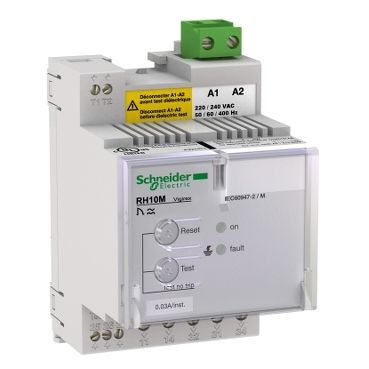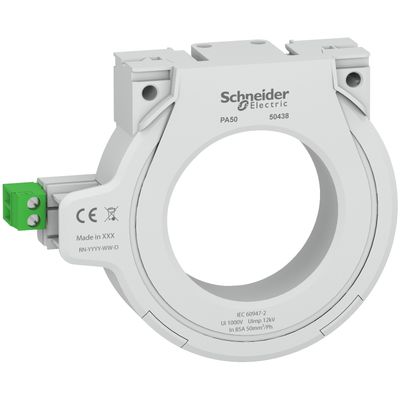

Earth Leakage Relays
⚡ Earth Leakage Relay (ELR)
Earth Leakage Relays (ELR)
detect leakage current to earth
using a core‑balance CT (CBCT)
and trip an upstream breaker when leakage exceeds a preset threshold.
They provide sensitive, adjustable earth‑fault protection
for industrial and commercial systems where RCCBs are not suitable.
🟦 What ELRs Do
- Monitor phase–neutral balance — detect residual current via CBCT.
- Trip upstream breaker — operate MCCB/ACB/contactor through shunt trip or UVR.
- Prevent shock & fire — catch low‑level insulation faults before they escalate.
🟧 Key Characteristics
- Adjustable sensitivity — typically 100 mA to 30 A.
- Adjustable delay — avoids nuisance tripping and enables selectivity.
- External CBCT — all phases + neutral conductors pass through one CT.
- Works with high‑current feeders — unlike RCCBs, which are limited in current rating.
🟨 Typical Applications
- Industrial panels
- Commercial buildings
- Motors & HVAC
- Long cable runs
- Marine/offshore
🟩 ELR vs RCCB (Quick View)
| Feature | ELR | RCCB |
|---|---|---|
| Sensitivity | Adjustable | Fixed |
| Time delay | Yes | No |
| External CT | Yes | No |
| Industrial use | Excellent | Limited |
| Shock protection | Depends on the setting | Strong (30 mA) |
🟫 Key Settings
- IΔn — leakage trip level (e.g., 300 mA, 1 A, 5 A).
- Time delay — instantaneous or delayed.
- Trip mode — latching or non‑latching.
⭐ One‑line summary
ELRs provide adjustable, sensitive earth‑fault protection for feeders and equipment by detecting residual current via a CBCT and tripping an upstream breaker.