
Control Components
Time switches and twilight switches are control devices used to automate the operation of electrical circuits based on time schedules or ambient light levels. They are commonly applied to lighting, heating, equipment control, and energy‑management systems.
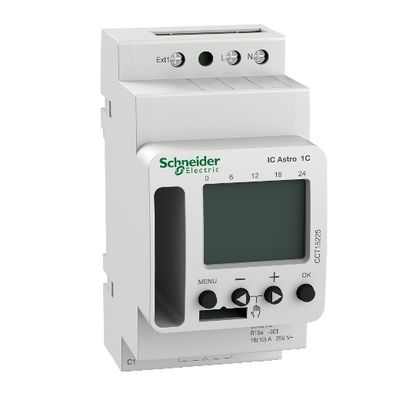
Digital Time Switch
Description
A digital time switch uses electronic circuitry to control when an electrical circuit switches ON or OFF. It typically features an LCD or LED display and push‑button or touchscreen programming. Some models include battery backup to retain settings during power loss, and selected types may support advanced automation interfaces.
Advantages
- High precision: Accurate timing based on electronic clocks
- Flexible scheduling: Daily, weekly, or multi‑programme operation
- Advanced functions: Holiday mode, random switching (presence simulation), countdown timers
- User‑friendly: Clear display with easy adjustment and status indication
Common Uses
- Indoor and outdoor lighting control
- Heating, ventilation, and air‑conditioning (HVAC) systems
- Industrial and commercial equipment requiring programmed operation
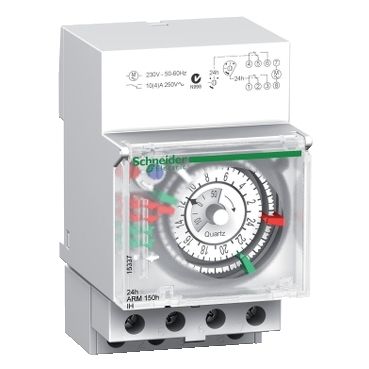
Mechanical Time Switch
Description
A mechanical time switch operates using a clockwork or motor‑driven mechanism. Switching times are set manually using a rotating dial, pins, or segments that represent ON and OFF periods.
Advantages
- Simplicity: Easy to understand and set without programming
- Robustness: Durable mechanical construction
- Independence from memory electronics: Switching cycle remains simple even during minor disturbances
Note: Although mechanical time switches do not require programming, most still rely on a small synchronous motor powered by the supply to keep the clock running.
Common Uses
- Garden and exterior lighting
- Water heaters
- Simple industrial or agricultural processes
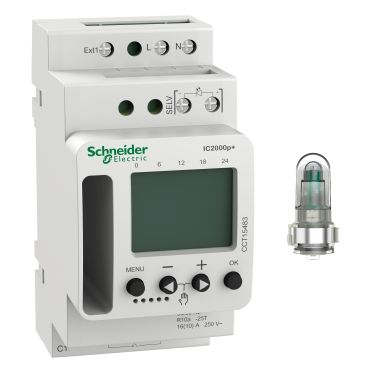
Twilight Switch (Photocell Switch)
Description
A twilight switch, also known as a photoelectric switch or dusk‑to‑dawn controller, operates according to ambient light conditions. It turns the connected circuit ON when light levels fall below a preset threshold and OFF when light levels rise again.
Advantages
- Energy efficiency: Operates lighting only when natural light is insufficient
- Fully automatic: No time setting required
- Improved security: Ensures lighting is active during hours of darkness
Common Uses
- Street and area lighting
- Outdoor security lighting
- Garden, pathway, and landscape illumination
Comparison Overview
| Feature | Digital Time Switch | Mechanical Time Switch | Twilight Switch |
|---|---|---|---|
| Control Basis | Time (electronic) | Time (mechanical) | Ambient light |
| Accuracy | High | Moderate | Light‑dependent |
| Complexity | High | Low | Low |
| Programming | Yes | No | No |
| Energy Efficiency | Good | Moderate | Excellent for lighting |
| Typical Use | Advanced automation | Simple schedules | Outdoor lighting |
Summary
- Digital time switches are ideal where precision, flexibility, and advanced scheduling are required.
- Mechanical time switches suit basic, reliable time‑based control with minimal setup.
- Twilight switches are optimal for lighting applications requiring automatic operation based solely on daylight conditions.
The choice between these devices depends on the application requirements, desired level of automation, and operational simplicity or efficiency.