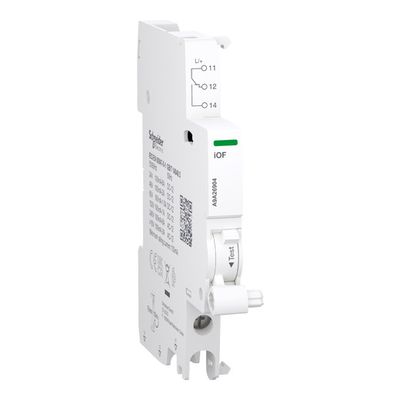

Acti 9 indication and tripping auxiliaries are modular accessories designed to enhance the functionality of Acti 9 protective devices such as MCBs, RCDs, RCBOs, switch disconnectors, remote‑control modules, and automatic reclosers. They provide remote status indication, electrical tripping, safety interlocking, and automated control functions in commercial and industrial electrical installations.

These auxiliaries are clip‑on modules that require minimal panel space while significantly improving monitoring, safety, and service continuity.


Main Types of Acti 9 Auxiliaries

1. Auxiliary Contacts (iOF, iSD, OF+SD)

Auxiliary contacts provide remote electrical indication of the operating status of the protective device.

  • Indicate ON/OFF position and TRIPPED state
  • Supply low‑current signals suitable for PLCs, relays, or monitoring systems
  • Compliant with IEC 60947‑5‑1
  • Available in standard‑current and low‑current versions for daisy‑chain monitoring of multiple devices

Purpose:
Remote monitoring, alarm signaling, and supervisory control.


2. Shunt Trips (iMX)

Shunt trips are electromagnetic tripping auxiliaries used for remote emergency disconnection.

  • Tripping occurs when the control circuit is energised
  • Used for emergency stop, fire alarm interfaces, and safety interlocks
  • Causes immediate opening of the associated circuit breaker

Purpose:
Remote forced tripping under safety or emergency conditions.


3. Under‑Voltage Releases (iMN)

Under‑voltage releases trip the protective device whenever the control voltage falls below a defined threshold.

  • Prevent automatic re‑closing after supply loss
  • Ensure equipment cannot restart unexpectedly
  • Supports both instantaneous and time‑delayed tripping versions

Purpose:
Protection against voltage dips and safe power‑failure response.


4. Over‑Voltage / Voltage‑Monitoring Trips

Voltage monitoring auxiliaries trip the device when abnormal voltage conditions occur.

  • Protect sensitive equipment from voltage excursions
  • Trigger downstream protective isolation via the circuit breaker
  • Often combined with control relays or system automation logic

Purpose:
Protection against network over‑voltage or unstable supply conditions.


5. Automatic Reclosers (ARA)

Automatic recloser auxiliaries restore supply after transient faults.

  • Performs automatic re‑closing after short‑duration faults
  • Locks out after repeated unsuccessful attempts
  • Improves continuity of supply in final distribution

Purpose:
Reduce downtime caused by temporary faults.


6. Remote Control Interfaces (RCA)

Remote control auxiliaries allow electrical closing and opening of circuit breakers.

  • Enables ON/OFF control without local access
  • Can be operated by control circuits or automation systems
  • Used in energy management and controlled distribution systems

Purpose:
Remote operation and automation of protective devices.


7. Visual Indication (VisiTrip / Status Indicators)

Visual indicators provide immediate physical identification of the faulted device.

  • Clear mechanical fault indication visible on the front of the breaker
  • Allows rapid fault detection and reduced intervention time

Purpose:
Fast local diagnostics and reduced maintenance time.


Key Advantages of Acti 9 Auxiliaries

  • Enhanced safety through remote tripping and voltage‑dependent protection
  • Improved service continuity with automatic reclosing and clear fault identification
  • Advanced monitoring via low‑current signalling compatible with PLC systems
  • Simple installation using clip‑on DIN‑rail accessories
  • Flexible combinations(e.g. iOF + iSD + iMX) to suit application needs

Typical Applications

  • Commercial and industrial distribution boards
  • Fire alarm and emergency stop integration
  • Building management systems (BMS) and automation panels
  • Energy monitoring and load management systems
  • Critical infrastructures requiring fast fault response

Summary

Acti 9 indication and tripping auxiliaries extend basic circuit protection into a fully monitored, remotely controlled, and automated system. By combining auxiliary contacts, shunt trips, voltage releases, automatic reclosers, and visual indication, Schneider Electric provides a scalable and standards‑compliant solution that improves electrical safety, reliability, and operational efficiency in modern installations.