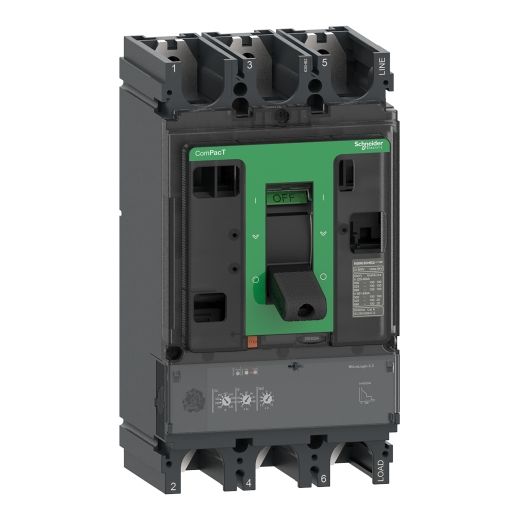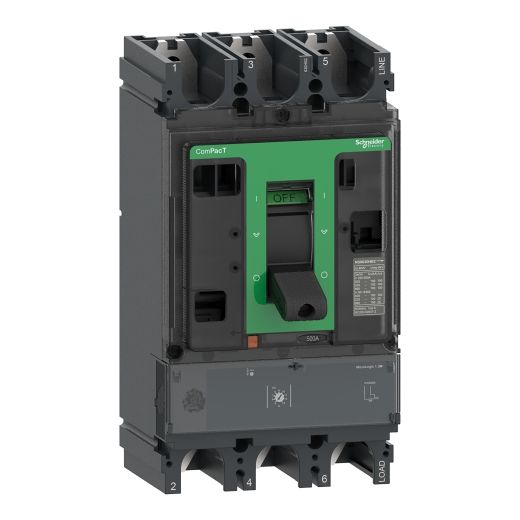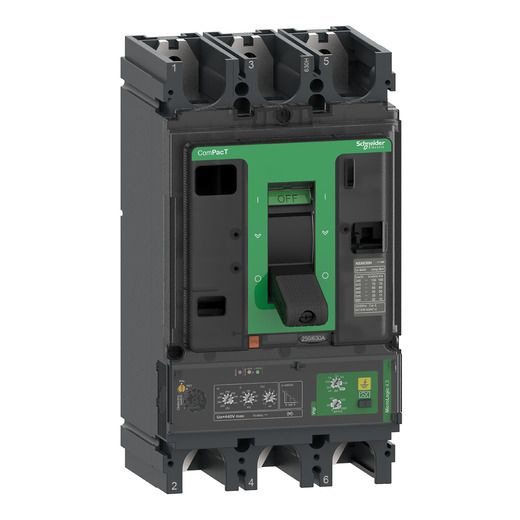

Frame size describes the breaker’s physical and mechanical envelope — terminal spacing, mounting footprint, accessory compatibility, and the family of trip units it accepts. A 630A frame is built to accommodate trip units and accessories rated up to 630A and to withstand the mechanical and thermal stresses associated with that class.

Rated (adjustable) current is the protection setting placed into that frame. A 630 A frame can usually accept trip units set to lower continuous currents (for example, 400 A or 500 A) if the trip unit supports those settings, but the frame’s short‑circuit withstand (Icu/Ics), terminal sizes, and mechanical characteristics remain those of the 630 A class.

What the 630A Frame Implies Practically

  • Mechanical envelope — larger terminals, wider pole pitch, heavier busbar interface, and specific mounting dimensions.
  • Accessory family — compatible trip modules, shunt trips, auxiliary contacts, and communication modules sized for the 630A frame.
  • Short‑circuit capability — the frame is engineered for particular Icu/Ics ratings (kA values) at system voltage; verify the exact kA rating for the model you choose.
  • Thermal capacity — the frame can dissipate heat for currents up to its rated continuous capability when installed per manufacturer guidance and derating rules.

Frame Size versus Rated Current — Key Distinction

Term Meaning Design Impact
Frame (630 A) Physical class and accessory family Determines terminal size, mounting, Icu options
Rated/Set current (In) Continuous current protection setting Determines when the breaker trips; can be set lower than frame max if supported
Breaking capacity (Icu/Ics) Ultimate and service-breaking capability in kA Must be ≥ prospective fault current at installation point

Selection Checklist for a 630A Frame MCCB

  • Confirm continuous load and choose a trip setting (In) appropriate for the load plus margin.
  • Calculate prospective fault current at the breaker location; ensure the frame’s Icu/Ics meets or exceeds that value.
  • Select trip unit type: thermal/magnetic for basic protection; electronic trip (with adjustable long‑time/short‑time/instant/earth‑leakage) for coordination, metering, and diagnostics.
  • Verify terminal and busbar compatibility: lug sizes, torque values, and busbar spacing must match the 630 A frame.
  • Account for environmental derating: ambient temperature, altitude, enclosure ventilation, and grouping of breakers can require derating of continuous current capability.
  • Perform a coordination study: ensure selectivity with upstream ACBs and downstream protection devices to limit outage scope.
  • Decide communications and monitoring needs: add communication modules if remote metering, event logs, or EcoStruxure integration are required.
  • Spare strategy: keep spare trip modules and critical accessories for rapid replacement.

Installation and Commissioning Practicalities

  • Follow the manufacturer's torque and wiring specs to avoid loose connections and overheating.
  • Pre‑commission tests: insulation resistance, polarity, mechanical operation, and primary injection to verify trip performance.
  • Document trip settings and keep them with switchboard records.
  • Thermal imaging during initial operation helps detect poor connections.
  • Periodic maintenance: mechanical operation checks, contact inspection, firmware updates for electronic trip units, and thermal scans.

Common Risks and How to Mitigate Them

  • Underspecified breaking capacity — always verify Icu/Ics against calculated fault level.
  • Oversizing frame unnecessarily — increases cost and can complicate selectivity; choose the smallest frame that meets breaking capacity and terminal requirements.
  • Improper derating — account for ambient temperature and enclosure conditions to avoid nuisance trips or overheating.
  • Cyber exposure with digital trip units — apply network segmentation, authentication, and firmware management when enabling communications.

Example Use Cases for a 630A Frame MCCB

  • Main feeder in medium‑sized distribution boards feeding multiple sub‑feeders.
  • Large motor feeders where motor starting currents and fault levels require a robust frame.
  • Service entrance or submain in commercial buildings where a compact MCCB solution is preferred over an ACB.

Filters

Filters