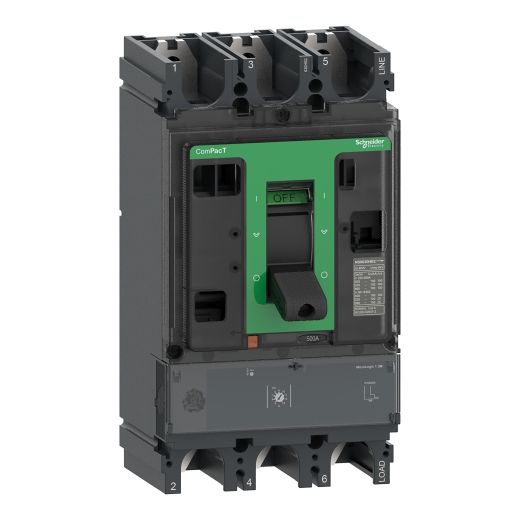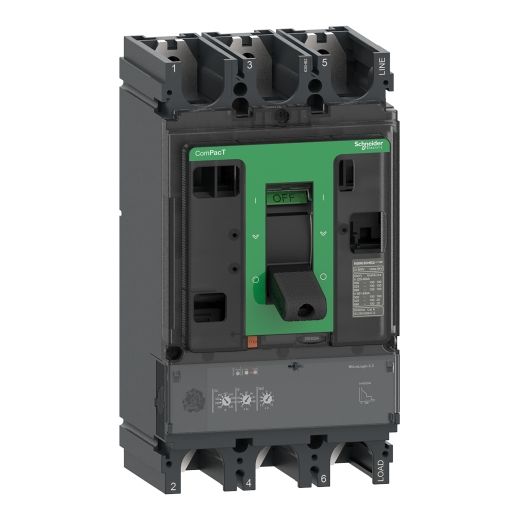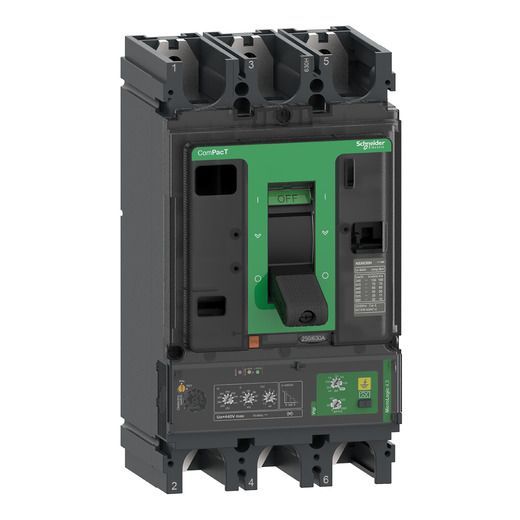

400A Frame
⚡ 400 A Frame MCCB
A 400A frame MCCB
defines the mechanical class
of the breaker — its physical size, terminals, and short‑circuit capability.
It is built to carry up to 400A continuously, but the actual protection rating (In)
depends on the trip unit, which may be set lower (e.g., 250 A or 320 A).
🟦 Core Distinction
- Frame size
—
The physical envelope: dimensions, terminal spacing, busbar interface, and accessory family.
A 400A frame is larger and more robust than 250 A or 160 A frames. - Rated/Set current (In)
—
The continuous load‑protection setting.
Adjustable within the trip unit’s range, but never above 400A.
🟧 Practical Implications
- Breaking capacity
—
Determined by the frame, not the trip setting; multiple kA options exist per model. - Accessory compatibility
—
Full suite: aux contacts, shunt trip, motor operator, comms modules. - Application fit
—
Medium‑to‑large feeders, motors, and LV distribution boards. - Flexibility
—
The same 400A frame can protect 250A, 320A, or 400A circuits, depending on the trip unit.
🟨 Quick Comparison
| Attribute | 400 A Frame | Rated Current (In) |
|---|---|---|
| Meaning | Physical size & accessory family | Protection setting |
| Range | Accepts trip units up to 400A | Adjustable (e.g., 250–400A) |
| Breaking capacity | Fixed by frame design | Independent of setting |
| Choose when | Panel layout & fault level require it | The load current dictates it |
🟫 Selection Checklist
- Match In to load
- Verify Icu/Ics ≥ prospective fault current
- Confirm terminal/busbar fit
- Choose trip unit type(TM vs electronic LSIG)
- Coordinate protection with upstream ACBs/MCCBs
- Derate for environment(temperature, altitude)
⭐ One‑line summary
A 400A frame MCCB is a physically larger, higher‑capacity breaker platform that accepts trip units up to 400A, with its mechanical strength and breaking capacity defined by the frame, not the trip setting.